High School Program
At TJ, the exchange of ideas becomes a way of life, and ideas are often valued more than answers.
Learning at TJ
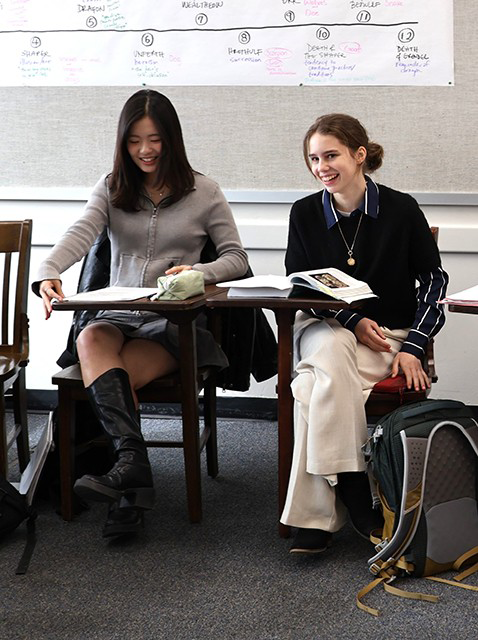
By high school, the exchange of ideas has become a way of life. You'll be expected to do more than learn the material in front of you. You'll begin to decide what you think about it, explain your reasoning, and listen closely when someone else reaches a different conclusion.
As the work becomes more advanced, you'll also have more independence in how you approach it. Teachers are still close by, but they increasingly expect you to take the lead in discussion, make connections between subjects, and recognize when an idea isn't fully developed.
A shared academic foundation
A demanding, time-tested course of study gives you something important in common with your classmates. You'll build a strong foundation in English, math, language, science, social studies, and art. As you get older, you'll have more choices about where you want to go further while continuing to share a core academic experience with your classmates. Over time, you'll be expected to go beyond knowing the material and consider what it means, how ideas connect, and whether the conclusions you reach can stand up to someone else's questions.
|  |
Distinguishing Features
|



High School Program
Your course of study may look a little different depending on where you begin. Students who enter in later grades can be placed appropriately within the curriculum, and math placement is based on readiness rather than grade level alone. International students may begin with English or social studies courses designed to strengthen the academic language they'll use throughout the curriculum.
Your High School Years |
| 9th Grade |
English 3: Honors Literature and Composition
In this course, students study grammar, write clearly and correctly, and engage in literary analysis through daily class discussions. Sentence diagramming and daily Outside Reading entries allow students to learn and internalize standard grammar through mechanical and creative processes, and the works we read this year, ranging from the ancient epic The Odyssey to Oscar Wilde’s decadent The Picture of Dorian Gray, encourage both analytical interpretations and explorations of human nature throughout millennia. Memorization of selections from our readings—speeches from The Tempest, Richard III, and Antigone, and from works adjacent to our readings—deepens students’ appreciation for specific rhythmic techniques and the beauty of language. As students enter high school, they transition from short-form writing to the longer essay; through gradually lengthened assignments, written and rewritten, students develop a sense of the shape of academic argument. The Honors Literature and Composition corpus is peopled with heroes, monsters, and villains who take great journeys, rise to the occasion, and, at times, fall short of expectations, and the shared themes in the texts will enable us to make connections despite the centuries and cultures that separate them.
Sample Reading List: The Odyssey; Beowulf; Grendel; Dracula; Richard III; The Metamorphosis; The Picture of Dorian Gray; The Tempest; Antigone; The Bluest Eye
Geometry and Introduction to Statistics
The initial and major part of this course introduces students to the postulates, definitions, and implications of Euclidean geometry. The partnership between algebra and geometry is essential throughout higher math and fundamental to future study. During our focus on geometry, the importance of spatial reasoning and the application of logical chains of thought are emphasized. In the fourth quarter, our focus turns to statistics. In a very direct way, this area of mathematics exists not just as symbols and curves on a blackboard but as a language useful for describing and understanding a wide range of everyday experiences. Throughout, real-world examples and the practical applications of computing technology—from graphing calculators to software—are highlighted. In the final weeks of the year, the course focus shifts from geometry to a general introduction to statistical concepts and methodologies.
Greek 1 - Homeric
Greek 1 provides students with a morphological and syntactical foundation of ancient Greek. Homer’s Iliad is the bridge for our study. The first half of the year focuses on memorization of both noun cases and verb conjugations; translation dominates the second half. Along the way, students learn the rules of dactylic hexameter, the meter Homer employed for both of his epics. In addition to scanning lines, students memorize and recite the initial part of the poem. Nestled into our work is the National Greek Exam, a test administered by the American Classical League, which we take in late February. As their skills increase, students review multiple translations to see the decisions made by “professional” translators. By year’s end, the class is adept at translating about ten lines an hour and ready for the challenges of Herodotus and the Attic authors they’ll encounter in Attic Greek the following year.
Ancient World History
This class focuses on the history of all inhabited areas of the world from the Paleolithic period to ca. 1500 CE. Students explore the political, social, economic, and cultural developments of major world civilizations. Emphasis is placed on studying history through primary sources. This course is inherently comparative, and students are asked to identify and discuss common patterns evident in the development of the world’s civilizations. Themes covered include patterns and impacts of interaction among major societies; the relationship of change and continuity across time; impact of technology and demography on people and the environment; systems of social structure and gender structure; cultural and intellectual developments and interactions among and within societies; changes in functions and structures of states and in attitudes toward states and political identities.
Accelerated Physics
Accelerated Physics is a course in which students explore a range of fascinating topics. From the vast expanse of the universe to the tiniest particles that make up matter, students delve into the world of science and discovery. Some specific topics covered include astronomy, cosmic history, and the description of motion. Students also explore Newton's laws of motion, conservation laws, and thermodynamics. As students delve into these complex concepts, they examine their real-world applications and impact on humanity. Additionally, the class discusses the importance of scientific literacy and how to critically evaluate scientific news and information. By the end of this course, students have a strong foundation in physics and a deeper appreciation for the wonders of the natural world. |
| 10th Grade |
English 4: Honors Literature and Composition
This course aims to train students to read reflectively, to write persuasively, and to ask and discuss important questions—about words, about right action, about purpose, and about literature and life. Students encounter religious texts (Torah, the Gospel of Matthew), narrative and epic poetry (Dante, Chaucer, Milton), drama (Shakespeare), the Bildungsroman or “novel of formation” (Wright), the short story (Joyce), and the formal lyric poem (Dickinson, Frost, and Keats, among others). Perhaps the predominant theme connecting these works is man’s relationship to God (or at least to the idea of God); other common themes include family, identity, gender, art, justice, and mercy. The various skills of literacy—close textual analysis, imitation of traditional forms, application of usage rules and principles of composition, the posing of useful questions, and the marshaling of persuasive answers—come together in the multi-paragraph essay, assigned as we finish each novel or play. Memory work, which develops students’ appreciation for rhythm and sound devices and focuses their attention on thematically important passages, includes selections from Dante and Shakespeare, as well as from more recent English-language poetry. Students examine and internalize the logic of English grammar through the practice of diagramming sentences, learning to put their command of the rules in the service of clear, effective communication.
Sample Reading List: Excerpts from The Bible; The Inferno; The Canterbury Tales; The Merchant of Venice; Hamlet; The Diaries of Adam and Eve; Dubliners; Black Boy; East of Eden; The Color Purple
Advanced Algebra/Trigonometry
This course bridges past material from Algebra 2 with a future study of Precalculus. Students cover linear, quadratic, rational, irrational, logarithmic, and higher degree functions. They also explore conics (circles, ellipses, hyperbolas) as well as sequences and series. Trigonometry is incorporated throughout the year. While many students have encountered these concepts before, the primary focus is to solidify their knowledge of the topic through real-world applications. Students are introduced to the graphing calculator and how to use it to find regression equations, analyze graphs and equations, and perform data analysis.
Greek 2 - Attic
With a year of Homer’s poetry behind them, the students now dive into Attic Greek prose. They begin their study by using Greek: An Intensive Course, created by professors Hardy Hanson and Gerald M. Quinn. This textbook reinforces much of the morphology students learned in Greek 1 and adds the syntactic constructions required to read sophisticated Greek prose. Sometime around mid-year, they set this book aside and apply their skills to a Platonic dialogue (over the years, TJ students have read the Ion, the Meno, and parts of the Republic). By the end of the year, successful students have the skills in place to continue reading Greek authors for both pleasure and lifelong illumination.
AP World History: Modern
In this introductory college-level course, students investigate significant events, individuals, developments, and processes from 1200 to the present. Students develop and use the same skills and methods employed by historians: analyzing primary and secondary sources; developing historical arguments; making historical connections; and reasoning about comparison, causation, continuity, and change. Taught in a seminar format, the course moves chronologically and centers on six themes that allow students to make connections among historical developments across different times and places—humans and the environment, cultural developments and interactions, governance, economic systems, social interactions and organization, and technology and innovation. Current events are a regular part of class discussion, as such themes connect the past to the present. The role of diverse ethnic groups and women over time is a particular focus. This course aims to cultivate independent thinking and informed and participatory citizenship.
Accelerated Biology (one semester)
This semester-long course is designed to lay the foundation for future study in AP Biology. In the first weeks of class, the students settle on a driving question, which then leads to a guiding question, for example, how organisms adapt to their environment or how they receive and respond to sensory input. They research foundational material, and as the class comes to better understand their topic, they then break apart the question into units. Throughout the units covered, the class achieves significant depth, creating a strong foundation for the AP science courses taken in the junior and senior years. The class also works toward designing and running a lab or project inspired by the course content. Over the course of the semester, students increase their science-language fluency and literacy; practice transforming dense, detailed material into an applicable, flexible worldview; and gain experience with current tools and methods in biological research. Along the way, they apply their knowledge to real-world situations, learning to think critically about environmental and social concerns and about media reporting of scientific research.
Accelerated Chemistry (one semester)
This semester-long course introduces fundamental concepts of chemistry, including atomic structure, chemical reactions, stoichiometry, acids and bases, kinetics, and properties of solids, liquids, and gases. The focus is on understanding how chemistry is applied in the real world and in one’s personal life. Students learn to take measurements and complete appropriate calculations using scientific calculators. Through interactive class discussions and investigative labs, students build reasoning skills that will help them through any future chemistry study. As a culminating exercise, each student completes a short scientific research paper on a topic of interest in chemistry. |
| 11th Grade |
AP English Literature and Composition
The syllabus contains challenging works of Western literature. Students learn to identify and interpret such components of imaginative literature as repetition, juxtaposition, connotative language, tone, and irony. In other words, they understand what is said by paying close attention to how it is said. These elements are as much a part of class discussion as is the identification and analysis of character, plot, setting, and theme. Complementing this classroom activity is the memorization and recitation of both lyric poetry and verse from Shakespeare. Students embroider their performance with the prosodic concepts they’ve studied throughout the year, with a special focus on replicating the metrical patterns and variations they discover in the text. Outside Reading moves away from summary and turns to analysis; students answer questions about their reading and incorporate sophisticated punctuation, prosodic elements, and rhetorical figures of speech into their responses. Five-paragraph analytical essays challenge the students to unite paragraphs organically, yoking both the strictures of grammar with the advantages of a crisp, idiomatic style. Taken as a whole, these skills prepare students for the AP test they may choose to take in May.
Sample Reading List: All the King’s Men; The Brothers Karamazov; The Rime of the Ancient Mariner; Chess Story; Arcadia; The Winter’s Tale; Pride and Prejudice; The Great Gatsby; Native Son; Invisible Man; Hamlet; Heart of Darkness; A River Runs Through It
Precalculus
This course builds on the specific knowledge and terminology learned in earlier math courses to establish a solid framework for future study in college-level classes. Students can examine all major topics with breadth and depth, including the solution of polynomials, the identification of trigonometric relationships, and the application of the rules of probability. During the second semester, fundamental calculus topics are covered, including the area under a curve, definite integration, and differentiation. Throughout the course, the importance of quantitative reasoning skills is emphasized, and the practical application of computing technology—from graphing calculators to software applications—is highlighted.
Modern-language elective: Accelerated Introductory French or Italian
Accelerated Introductory French - This beginning course takes a scaffolded, balanced-skills approach to building proficiency in speaking, listening, reading, and writing. Students learn the structures and systems of the French language: grammar, syntax, vocabulary, pronunciation, and spelling. From the outset, the course emphasizes language in context and is conducted in French. Students also begin to learn about francophone culture in various parts of the world, including our immediate area, which has a deep historical connection to France. The course is built on a multi-media language program, D’accord! Level 1. In addition to introducing grammatical structures and vocabulary, D’accord includes dramatic and authentic videos, literary and cultural texts, and embedded online tools that provide reinforcement through practice and assessment. The Accelerated Introductory French program is enhanced by expanded work during a weekly lab session, special projects, and at least one field trip.
Accelerated Introductory Italian - This course provides a general introduction to the Italian language contextualized in Italian culture and heritage. Using the course textbook, Sentieri: attraverso l’Italia contemporanea, students are introduced to every Italian verb tense and some of the non-indicative moods, as well as pronunciation and basic syntax. Emphasis throughout the course is on developing listening, speaking, reading, and writing skills. By the end of the course, students can understand and provide accurate responses to both written and spoken Italian. Assessments include regular quizzes and periodic projects such as in-class presentations, skits, posters, and brochures. In addition to using the textbook, students watch several Italian films while examining their cultural and historical relevance and their use of language. The course is conducted primarily in Italian, though English is sometimes used for clarification or explanation.
AP Elective
Biology, Chemistry, Physics C, or AP U.S. Government and Politics
AP Biology - The range and depth of material covered in AP Biology is meant to simulate a first-year college survey in biology, culminating in the optional AP Biology exam. The AP curriculum provides a useful structure for synthesizing themes across the field of biology and offers the possibility of earning college credit. The course will explore the players and processes at all levels of biology, including biochemistry, cells, genetics, plant and animal physiology, ecology, evolutionary biology, and the diversity of organisms on Earth, organized into units in line with the College Board’s Four Big Ideas for AP Biology. Required investigative labs meet for 90 minutes every week, and experiments culminate in a formal lab report or poster presentation. The labs combine inquiry-based and skill-development bench work, developing skills in communication, teamwork, and critical thinking. Throughout the year, students gain facility by compiling, translating, and summarizing peer-reviewed scientific research, writing a college-level research paper, and giving a professional presentation to colleagues.
AP Chemistry - The class covers many of the same topics as a first-year college chemistry course, focusing less on factual recall than on application of the concepts. Topics include atomic structure, chemical reactions, equilibrium, gases, solutions, thermodynamics, chemical kinetics, and electrochemistry. As required by the College Board, inquiry-based labs take place weekly, and a lab report is expected at the end of each experiment. Throughout the year, students work on a year-long research paper and present their findings to their peers at the end of the year.
AP Physics C - This course emulates a first-year, college-level physics class that uses calculus as a base. The goal is to help students develop a strong understanding of basic principles and be able to perform and analyze laboratory experiments. This course provides a systematic development of the concepts, principles, and scientific practices used in the study of physics with an emphasis on student inquiry and critical thinking. Both in class and in the lab, students have opportunities to form connections and gain enduring understandings of the foundational principles of physical reasoning. Students entering this course will have already completed Accelerated Physics and a sequence of math classes through (or concurrent with) AP Calculus BC. The first semester of the year is spent on the Mechanics portion of the AP test, and the second semester focuses on the Electricity and Magnetism section. Each student completes a year-long research paper or project to present to their peers after the AP exam.
AP U.S. History
This course is an in-depth, college-level survey of American history from the origins of North American civilizations in the United States to the present day. Current events are a regular part of class discussion as themes are connected from the past to the present. The class is taught chronologically and thematically in a seminar format, with a focus on the development of historical thinking skills. These skills include chronological reasoning, comparing and contextualizing historical developments, crafting historical arguments using evidence, and interpreting and synthesizing historical narratives. Students develop a critical understanding of the history, geography, environment, economic, political, cultural, and social institutions, religion, labor (including free, indentured, and slave), and values of the United States as expressed in both their unity and diversity. The role of minorities and women over time is a particular focus. The impact of judicial decisions (as well as an analysis of their reasoning) is a continuing topic of discussion. The second semester is centered on foreign policy, including war, diplomacy, and the effects of globalization. Students hone their ability to read, view, and analyze historical evidence and interpretations, and to express historical understanding in writing and discussion. This course cultivates participatory citizenship and encourages the development of independent, knowledgeable young adults who can conduct their lives in accordance with democratic and ethical principles. |
| 12th Grade |
* Students who have completed the AP math requirement in the junior year elect an additional AP course in science, social science, or math. Students must complete at least one AP Science course and one AP math course.
AP English Language and Composition
This required Advanced Placement course prepares students in rhetoric, the classical art of persuasion, through Socratic discussion of the readings and through nearly daily writing practice in narrative, argumentative, analytical, and expository discourse. These methods train students to back claims with detailed evidence, to investigate assumptions about the most important matters, and to present their ideas and stories in the most arresting and convincing manner. Our reading list of contemporary and classic authors centers on themes of identity and happiness within three expanding circles of immediacy—home, nation, and religion—and raises meaningful questions. How do the homes and communities in which we grow shape our sense of self? What are our relationships or obligations to one another? How are these different for those who hold power within a community? How do our religious beliefs create both bonds and conflicts within our communities? Outside Reading focuses on using textual evidence and distinguishing between paraphrase and short quotation. Students also produce a research paper on an ongoing cultural debate that impinges upon two of these circles. In it, students examine opposing points of view and look for ways that the classical voices we read can bring insight into a modern debate. In the final quarter, in a long-standing school tradition, the students take over the class, helping to choose the readings (different every year but related to the course's broad themes), organizing seminars, making assignments, leading discussions, and correcting the writing projects.
Sample Reading List: The American; Democracy in America; The Second Sex; Notes of a Native Son; In Cold Blood; Where You Go Is Not Who You’ll Be; The Prince; Macbeth; King Lear; Nickel and Dimed; “Stranger in the Village”
AP Calculus BC or AP Statistics
AP Computer Science Principles or AP Computer Science A may be an elective option for those who complete AP Calculus BC before 12th grade.
AP Calculus BC - This course explores material typical of a college-level course in calculus. The major areas covered are differential calculus, integral calculus, and polynomial expansion and approximation. The topics are completed by the beginning of the fourth quarter, leaving time to review for the AP exam. Students have daily homework, assessments, and a final project (to be determined by the class at the end of the year). The long-term goal of this course is to simultaneously prepare students for the AP exam and provide strong preparation for their college mathematics courses, all while reflecting on their math careers to date.
AP Statistics - This course presents a systematic development of the concepts, principles, and tools of statistics with an emphasis on inquiry and critical thinking. From characterizing data to developing regression-based predictions to applying tools such as confidence intervals and hypothesis tests for decision-making, this course builds on the TJ math curriculum's foundational framework to broaden students' mathematical horizons. While the theoretical basis of statistics is discussed, the important role of real-world application underlies most assignments and assessments. As a culminating assessment, students are charged with sharing a statistical exploration of a topic of personal interest in the form of a written paper and presentation.
Accelerated Intermediate French or Italian
Accelerated Intermediate French - Building on the previous year’s foundation, Accelerated Intermediate French addresses more advanced grammatical structures—including new tenses, moods, and sentence patterns—that enable students to communicate more accurately and authentically in the target language. A consistent emphasis on language in context and an exclusive use of French in the classroom help students build confidence as they use these new structures in their speaking and writing. The D’accord! Level 2 program plays a central role in daily practice and assessment: its audio and video selections are invaluable resources for improving listening skills. In the second half of the year, students are introduced to French literature by explicating, memorizing, and reciting a classic French-language poem. Later, they read one or two short novels, including Saint-Exupéry’s Le Petit Prince. Near the end of the year, students explore the legacy of French colonialism in and around Missouri and apply their language skills to a research project and/or field trip.
Accelerated Intermediate Italian - The goal is to develop proficiency in speaking, listening, reading, and writing the Italian language as well as to learn about Italian history and culture. We review and expand upon verb tenses, noun and adjectival constructions, and vocabulary learned in Accelerated Introductory Italian, and add more advanced constructions, including hypothetical statements and indirect discourse, while examining authentic content in a variety of formats. Class is conducted in Italian, and students are expected to avoid speaking English. While the course textbook, Immagina: L’italiano senza confini is used throughout the year, the fourth quarter is dedicated to reading an Italian work of literary merit in its entirety. Emphasis in Accelerated Intermediate Italian is on the practical use of the language, both in real-world scenarios and in discussions of topics that arise in students’ daily lives.
AP Elective
AP U.S. Government and Politics (one semester, taught in combination with Comparative Gov.)
In AP U.S. Gov, students gain an analytical perspective on government and politics in the United States. They study both the general concepts used to interpret the U.S. government and politics and analyze specific historical and contemporary examples. They become familiar with the various institutions, groups, beliefs, and ideas that constitute the United States Government and the political process. We study six major topic areas throughout the year: the constitutional underpinnings of the United States Government; political beliefs and behaviors; political parties, interest groups, and mass media; institutions of national government; public policy; and civil rights and civil liberties.
AP Comparative Government and Politics (one semester, taught in combination with U.S. Gov.)
This course introduces students to the tools used by political scientists to understand political processes and institutions. Our main topics include sovereignty, authority, and power; political institutions; citizens, society, and the state; political and economic change; and public policy. To understand these concepts in concrete settings rather than in abstract theory alone, we also undertake an in-depth study of six core countries: China, Great Britain, Iran, Mexico, Nigeria, and Russia. We also discuss the United States and the European Union to provide context.
Applied Research Principles
Upper School Elective (non-AP): Research principles are applied in virtually every field and profession, whether for academic purposes or pragmatic goals such as understanding the market for product placement or user satisfaction. Regardless of the research intention, the process is similar. According to the American sociologist Earl Robert Babbie, “research is a systematic inquiry to describe, explain, predict, and control the observed phenomenon.” This course will guide the student through each step of the process, exploring a topic of their choosing and resulting in a project that reflects mastery of the principles that frame this system of inquiry. The goal of this course is to instill in the student an understanding of how their work contributes to and fits within a larger body of evidence surrounding their topic. |
| Arts |
At Thomas Jefferson, a classical liberal-arts education means much more than the study of Greek and Latin. Its object of study is “the best that has been thought and said.” Above all, a liberal-arts education will push and keep wide open the two doors of higher learning: numbers and words. Therefore, we aim to ground students in the fundamental subject areas of English, math, language, social studies, science, and art over all six years of the program.
Art History
Art History: The 19th Century (Prerequisite: None)
This course introduces students to a conceptual understanding of art history by exploring the major movements as the nature of art changed during the Industrial Revolution. Emphasis is placed on exploring how the invention of photography changed the artist's role, patronage, subjects, and motivations in the 19th century. We begin by examining the influence of the Beaux-Arts on the realism of the Baroque and Romantic periods, move through Impressionism, as reflected in the Salon des Refusés, and culminate in early Expressionism by 1900.
Art History: The 20th Century (Prerequisite: None)
This course introduces students to a conceptual understanding of art history by exploring the major movements as the nature of art changed in the 20th century. Emphasis is placed on exploring how the challenges and conflicts in modern society were reflected in the arts. We begin by looking at the rise of Expressionism and Surrealism before moving on to Cubism, Pop Art, and postmodern work in the later decades.
Art History: The Renaissance (Prerequisite: None)
This survey course looks at the evolution of European art from 1400 to 1650. Growing out of a tradition dominated by the Catholic Church during the Medieval era, the artists of the Renaissance drew inspiration from the art of ancient Greece and Rome, while rediscovering the principles of perspective, shade, and shadow, and the use of light. The class explores changing styles and content themes as they relate to a shifting patronage base in the period.
Art History: Architecture (Prerequisite: None)
This course introduces students to a conceptual understanding of art history by exploring the major movements in architecture. We begin in the first quarter by examining the patterns and evolution of the designs of the societies of ancient Egypt, Sumeria, Greece, and Rome. The second quarter focuses on the Baroque and Neoclassical periods, highlighting the Beaux Arts School. The course ends in early Modernism by 1900 with the advent of technology in the Industrial Revolution.
Visual Art
Drawing 1 (Prerequisite: None)
An introduction to the fundamental concepts and techniques of drawing using a variety of black-and-white media forms the core content of this course. There is a strong emphasis on introductory perceptual drawing skills, such as perspective, spatial relationships, and contrast through line and value. The students work both directly from observation and from photo references. Coursework includes vocabulary development, critical analysis activities, and references to historic models of drawing.
Painting 1 (Prerequisite: Drawing 1)
This foundational course uses project-based exercises to introduce students to a variety of media and techniques. To gain an understanding of the “building blocks” of painting: value, proportions, and color theory. Additionally, two-dimensional design principles, including balance, rhythm, repetition, and unity, are addressed through various assignments, emphasizing the importance of composition in constructing images. Students’ experience includes the following materials: pencils, markers, watercolors, acrylics, and mixed media. Projects may include, but are not limited to, landscape, still life studies, and botanical illustration.
Introduction to Ceramics (Prerequisite: None)
This is an introductory course in ceramics designed for students with little or no previous experience working with clay. The hand-building techniques of pinch, coil, and slab, along with basic throwing, are covered using demonstrations, slide presentations, and practice. Students explore a variety of surface-decorating techniques, including texture, slips, underglazes, and glazes. Students become familiar with ceramic vocabulary and primitive- and kiln-firing techniques, participate in class critiques of class work, keep a sketchbook, and write a review of a local ceramic show as they interact and learn in an inquiry-based learning environment, comparing and contrasting various artists, periods, and styles.
Advanced 2D Visual Art (Prerequisite: Drawing 1, or permission from the instructor)
This course teaches more advanced techniques used in drawing and painting. Project-based exercises acquaint students with new media and techniques and lead them to develop increasingly more sophisticated images. Students also develop a thorough understanding of color theory and the relationships the Munsell Color System establishes among hues, tints, and shades of various chroma. Projects may include, but are not limited to, portraiture, landscape, still life studies, and figure drawing. The prerequisite for all students is Drawing 1 or the equivalent art class and/or experience.
Science Illustration (Prerequisite: Drawing 1)
Both biologists and artists use visualization to understand the world and communicate. In this course, students critique scientific illustrations and explore their role in education and the science community through reading, discussions, and visual studies in a field journal. The bulk of the semester is spent researching a biological topic to complete the semester portfolio. The portfolio includes a set of scientific drawings that clearly explain a biological topic. In addition, students complete a thought-provoking, creative piece in any medium of the students’ choosing, offering commentary on a biological topic.
Digital Art
Graphic Design (Prerequisite: None)
This course teaches the basics of Adobe Photoshop, Illustrator, and InDesign through various industry-related projects. Students begin to understand the basics of graphic design, including typography, composition, and color usage. Projects for print and web may include logo design, brochures, flyers, social-media graphics, and résumé design. Some creative skills (e.g., drawing, photography) are helpful but not required.
Photography 1: Digital Photography and Composition (Prerequisite: None)
Students learn the basics of smartphone cameras and their extensive editing features through the iPhone Photography School curriculum, including topics such as angles, leading lines, composition, symmetry, shadows, and lighting. After learning from video-based modules, students take photos around campus, then return to the classroom to reinforce and practice the techniques and features taught, and to analyze images based on lessons learned in our course. Since this class also serves as a photography pool for the yearbook, some assignments revolve around school events (e.g., class trips and athletic competitions). Each quarter, students submit their top two photos from class for possible inclusion in the arts showcases; the group then collaborates to determine final showcase selections.
Publications: Introduction to Adobe Creative Cloud Suite (Prerequisite: Photography 1)
Students must know the fundamentals of composition and digital photography editing before joining this advanced class. The program begins with a foundation in photo selection, design principles, and layout concepts used in print processes. Students are introduced to Adobe Photoshop and learn to use its interface and features. Lessons focus on various image-editing processes. Photo assignments are given, and students practice Photoshop editing on their own images. The second part of the semester focuses on Adobe InDesign’s workspace and tools to build documents with master pages. Students work with text, type, and styles while integrating graphics, photos, and color in their layout designs. Adobe Bridge, Illustrator, and Lightroom are briefly introduced.
Filmmaking 1 (Prerequisite: None)
Students experience both the creative and technical aspects of filmmaking while learning about historical and contemporary traditions. Story writing, story-based display, basic visual composition, and general reproduction skills are included with camera techniques, animation, and line action planning. Traditional filmmaking techniques may be extended with video and multimedia technologies. Interdisciplinary experiences lead to the refinement of a personal aesthetic and a heightened understanding of career opportunities in art and arts-related fields.
Music
Music Appreciation (Prerequisite: None)
In this course, students develop the ability to understand, evaluate, and—most importantly—enjoy music. The course introduces the basic musical elements of pitch, melody, harmony, and rhythm and explores musical genres and conventions from diverse cultures and historical periods. Classroom activities include listening exercises, discussion of assigned readings, and creative presentations or performances.
Music Ensemble (Prerequisite: Six months of formal musical instruction or consent of the instructor)
Members of the TJ ensemble explore diverse musical styles, hone their individual musical skills, and learn how to arrange, rehearse, and perform as a group. The instructor and students select the pieces to be learned; some are rehearsed and performed by the entire ensemble, while smaller groups within it perform others. Every student is required to participate in at least one live or recorded performance for the TJ community.
Music Theory (Prerequisite: A minimum of three months of formal instrument study)
This course addresses those concepts most immediately useful to performing musicians. The semester will begin with an introduction to standard musical notation, the essential language of many subsequent lessons and exercises. Other forms of notation, such as guitar tablature and lead sheets, may be examined as well. Among the course’s major topics are scale and chord construction, intervals, syncopation, and part-writing. Quizzes, drills, and projects assess students’ theoretical understanding of these concepts as well as their ability to apply them to musical situations.
Theatre
Drama: Directing (Prerequisite: None)
Making theater requires the vision and creativity of many participants, but a single vision unifies them into the show the audience experiences. The director’s job is to bring a broad perspective to the show and facilitate each person on the team into a single production. The director not only orchestrates the actors and the characters they develop but also finds ways to move those characters on a stage designed by the scenic staff, lit by the lighting designer, and heard by the sound crew. This course immerses students in the role of director, in which each student directs a short one-act play cast with their classmates as actors. All students in the class are expected to direct as well as perform. Those plays are rehearsed throughout the semester and performed in a one-act festival at the end of the term.
Drama: Improvisation (Prerequisite: None)
Imagine being able to create an entire scene without memorizing a script! Improvisation is where theatre began. When most of the world was illiterate, entire plays were improvisational works developed through established characters and plots. These “plays” were developed using the improvisational methods of trial and error, responses to the audience and actors, and repetition. Every actor, at some point, will be in the unenviable position of being “stuck” on stage. Whether a fellow actor missed an entrance or blanked on their line, knowing how to respond and keep the story moving, and get it back on track is a crucial skill. This course requires students to focus, listen, respond, and create. The classroom becomes experimental, allowing students to try new ideas and forms of expression. Physical movement is imperative to visually mold your character in the audience’s mind.
Scenic Design (Prerequisite: Perspective Drawing, Drawing 1, or Color Systems)
This course develops the basic skills for designing and building components of a theatrical production set. Areas to be covered include the fundamentals of set design, composition, and functionality; time periods; building props; acquiring furniture; and applying faux finishes. The director, the instructor, and the class develop a single, final design using components of each student’s individual efforts. All members of the class collaborate to design, draw, and build a model of a set for either the all-school play (fall semester) or the eighth-grade play (spring semester). In the second half of the course, students are expected to participate in constructing the set from the class’s design. They are required to learn how to safely use the tools necessary to construct scenery. The class loads the set for the play into the theater space and, after the performances, strikes it. Students taking the course over multiple years are guided in learning and accomplishing more complex aspects of the design, as well as in mentoring less experienced students. Load-in and strike are mandatory and carry significant weight in the final grade. |
Advanced Placement Courses and Upper-level Electives
 |
|
Advanced Placement (AP) courses are equivalent to a first-year college course, and each teacher’s syllabus must be approved by the College Board. For each of these courses, the student may take a nationally standardized exam in May. In general, AP is the most challenging level available to a high-school student in any subject. The advantages of successfully completing AP courses and exams are the possibility of earning college credit and/or exemption from first-year requirements in foundational disciplines.
A typical TJ student graduate has taken 8 AP classes: 1 in grade 10, 3 in grade 11, and 4 in grade 12; students accelerated in math take an additional AP class. AP is the only level for English, math, science, and social studies courses in grades 11 and 12.
AP Offerings |
| English |
AP English Literature and Composition |
| Science |
AP Biology
Every student must take at least one of these three. |
| Math & Computer Science |
AP Calculus BC |
| Social Studies |
AP U.S. Government and Politics
AP U.S. Government and Politics and AP Comparative Government and Politics are taught over one semester each. |
| Independent AP Study |
Students may request to take one AP exam for which they have studied independently (that is, not a course taught at TJ) each year. To do this, they must inform both their advisor and the Director of College Counseling by October 1 of that year, which exam they plan to take, and a study plan. In addition to paying the College Board exam fee, they will also have to pay for the exam proctor. |
Upper-level Research |
Applied Research Principles
This upper-level elective course introduces students to research as a systematic process used across disciplines to describe, explain, predict, and evaluate complex phenomena. Students learn to conduct ethical, evidence-based inquiries through both inductive and deductive reasoning, drawing on real-world observations and emphasizing accuracy, clarity, and intellectual rigor. Over the course of the year, students develop an original research project on a topic of their choosing, progressing through each stage of the research process: defining a problem and its significance; reviewing and synthesizing relevant literature to identify gaps and establish a theoretical framework; formulating hypotheses or research questions; designing and implementing a methodology for data collection and analysis; presenting findings through appropriate visual and analytical means; and drawing conclusions that situate their work within a broader body of knowledge while acknowledging limitations and opportunities for further study. Emphasis is placed on following this structured process with fidelity, ensuring that students not only produce a substantive final project but also develop a transferable understanding of disciplined inquiry.
Beyond the Classroom |
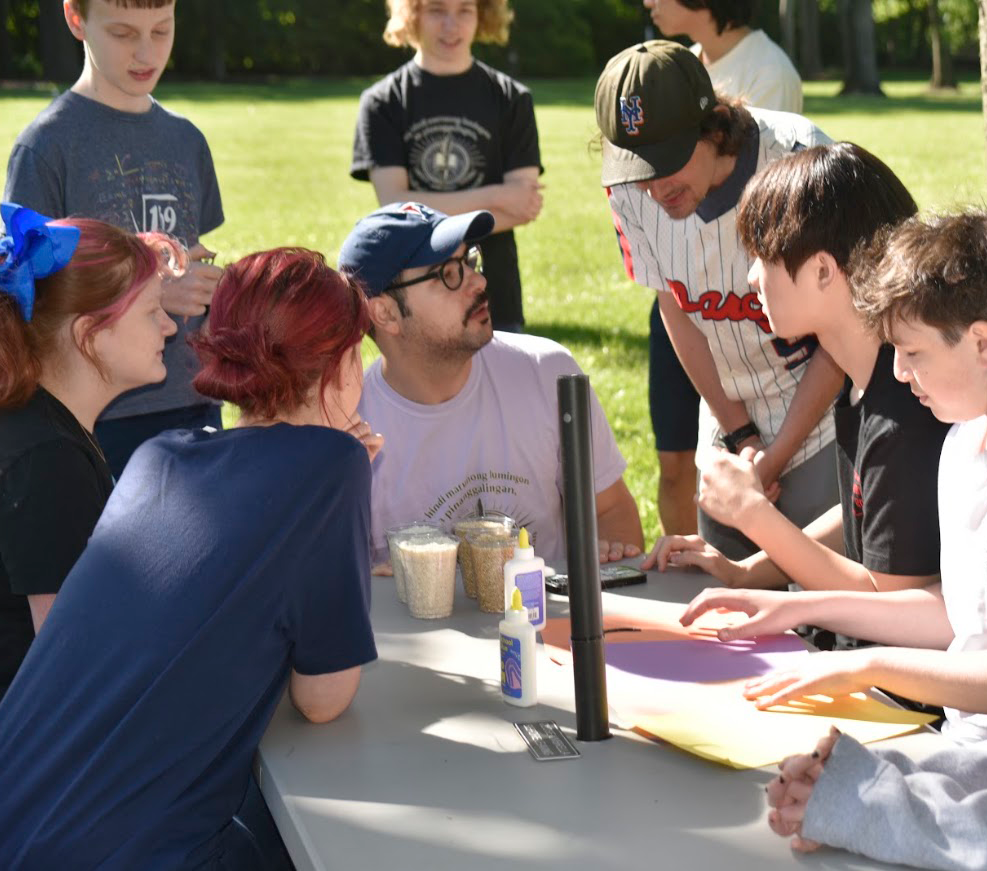
In addition to academic requirements, students must also participate in athletics, service-learning, and co-curricular programs.
| Athletics |
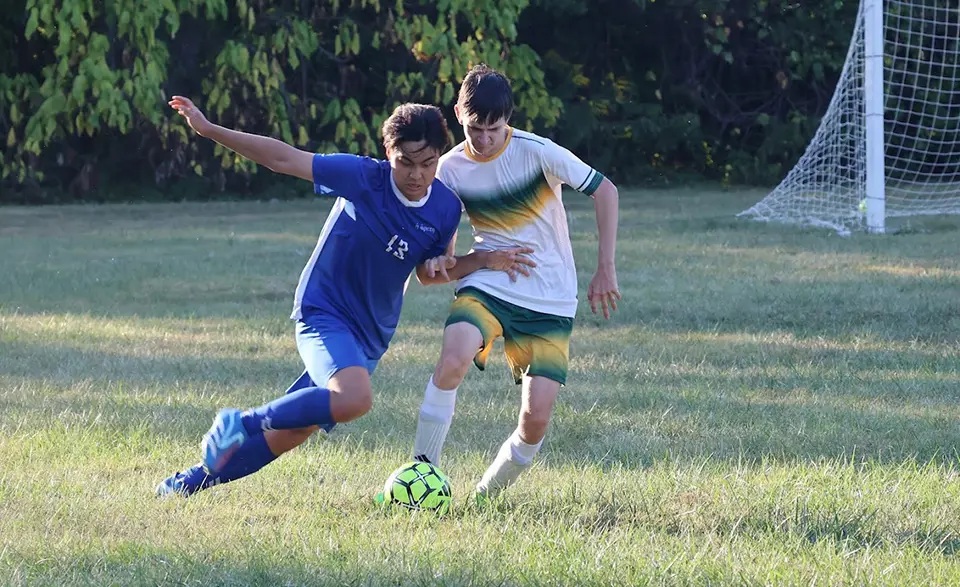
Participation in athletics is required but ungraded. Students elect up to three sports per year at the JV, varsity, or intramural levels. Students may request an exemption from the school program to continue with established athletic pursuits outside the school’s offerings (e.g., dance, swimming, baseball, gymnastics). |
| Service Learning |
All students do service outside of the school community and participate in the annual all-school Service-Learning Day. The number of required hours of service varies according to when a student entered TJ. If a student starts in 9th grade or earlier, the requirement is 75 hours; if a student enters 10th grade, the requirement is 60 hours; in 11th grade, 45 hours; and in 12th grade, 30 hours. All service hours must be completed while the student is in grades 9-12 and before the beginning of senior year. |
| Co-Curricular Learning |
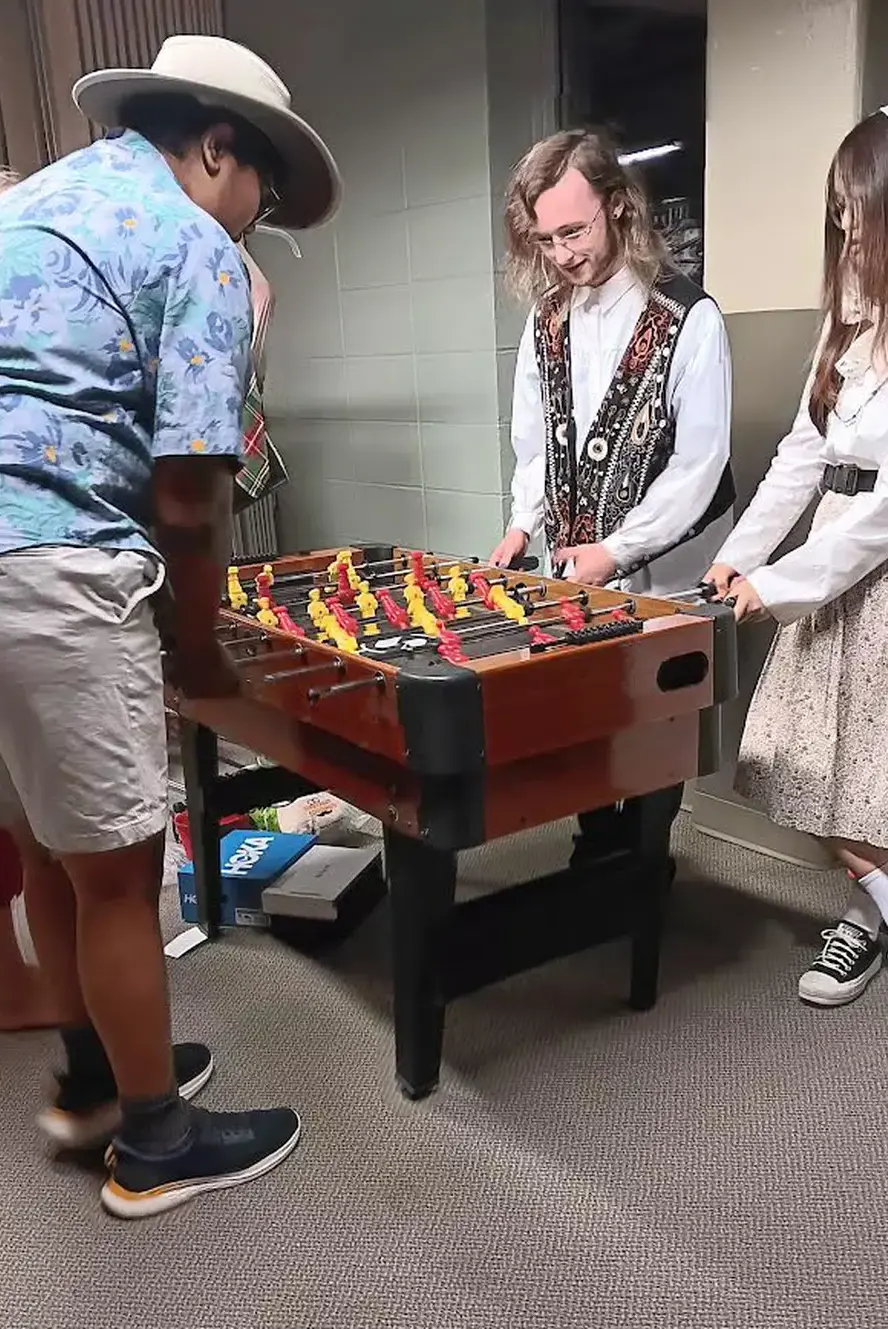
TJ's co-curricular programs balance students' social, physical, and emotional growth by supporting and encouraging their personal development outside the classroom and inspiring their involvement in both the TJ community and the world beyond. These ungraded courses are incorporated into every student’s weekly schedule. |